
Ennis Plastic Surgery · Beautiful Medicine™
AlloClae Breast Augmentation in Boca Raton
AlloClae is a newer structural adipose tissue option for selected patients seeking subtle breast volume, improved contour, or better symmetry without traditional breast implants or donor-site liposuction.
Explore the ProcedureProcedure at a glance
- Surgeon
- Dr. Vincent Riccelli, MD
- Location
- Boca Raton, Florida
- Focus
- AlloClae Breast Augmentation
- Consultation
- In-Office & Virtual
A personal approach
Your consultation
with Dr. Riccelli.
At Ennis Plastic Surgery, Dr. Vincent Riccelli specializes in breast revision, breast rejuvenation, and body contouring. He evaluates whether AlloClae may be appropriate as a stand-alone breast enhancement or as part of a broader plan involving breast lift, implant exchange, implant removal, fat transfer, or revision surgery.
AlloClae is not a breast implant and is not the same as traditional fat grafting. It is a ready-to-use, donor-derived structural adipose tissue allograft placed beneath the skin in areas where fat naturally exists. Its role is generally localized contouring and modest volume rather than a dramatic increase in breast size.
 Meet Dr. Riccelli
AlloClae Breast Augmentation Quick Facts
A New Non-Implant Option for Subtle Breast Volume
What It Is
Ready-to-use structural adipose tissue derived from donated human fat tissue and intended for localized subcutaneous cushioning and support.
Best For
Selected patients seeking modest volume, contour refinement, improved symmetry, or soft-tissue support without traditional implants.
No Donor-Site Liposuction
Unlike traditional fat transfer, AlloClae does not require harvesting fat from the patient’s abdomen, flanks, thighs, or another area.
Limitations
It is not designed to create the same predictable enlargement, projection, or shape as a breast implant.
Understanding the procedure
What Is AlloClae?
AlloClae is a processed human adipose tissue allograft. It is made from donated human fat tissue and prepared to preserve the tissue’s natural three-dimensional architecture and extracellular matrix.
The product is intended to be placed beneath the skin in localized areas of the body where adipose tissue naturally exists. In breast applications, this may allow a surgeon to add cushioning, support, or modest volume to selected areas.
Because it is supplied ready to use, AlloClae does not require the liposuction and fat-processing steps associated with traditional autologous fat transfer. This may make it relevant for patients who are very lean, do not want donor-site surgery, or need a relatively focused amount of soft-tissue enhancement.
AlloClae should be understood as a localized tissue-volume option—not a direct substitute for every breast implant or fat-transfer procedure.

Soft-tissue volume support without an implant
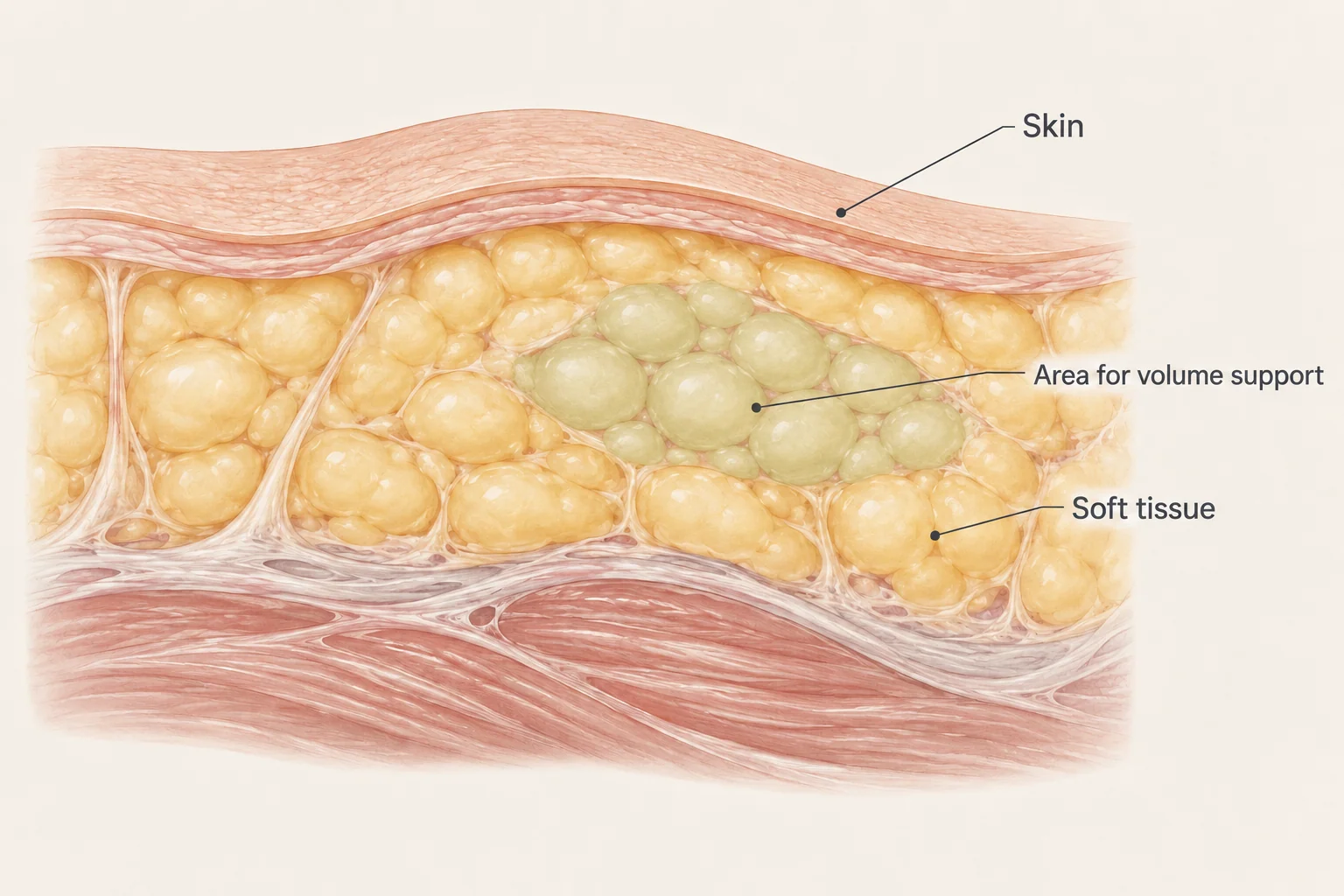
AlloClae uses donor-derived adipose tissue for selected volume concerns. This conceptual tissue diagram illustrates volume support; it does not show an implant or a predicted breast result.
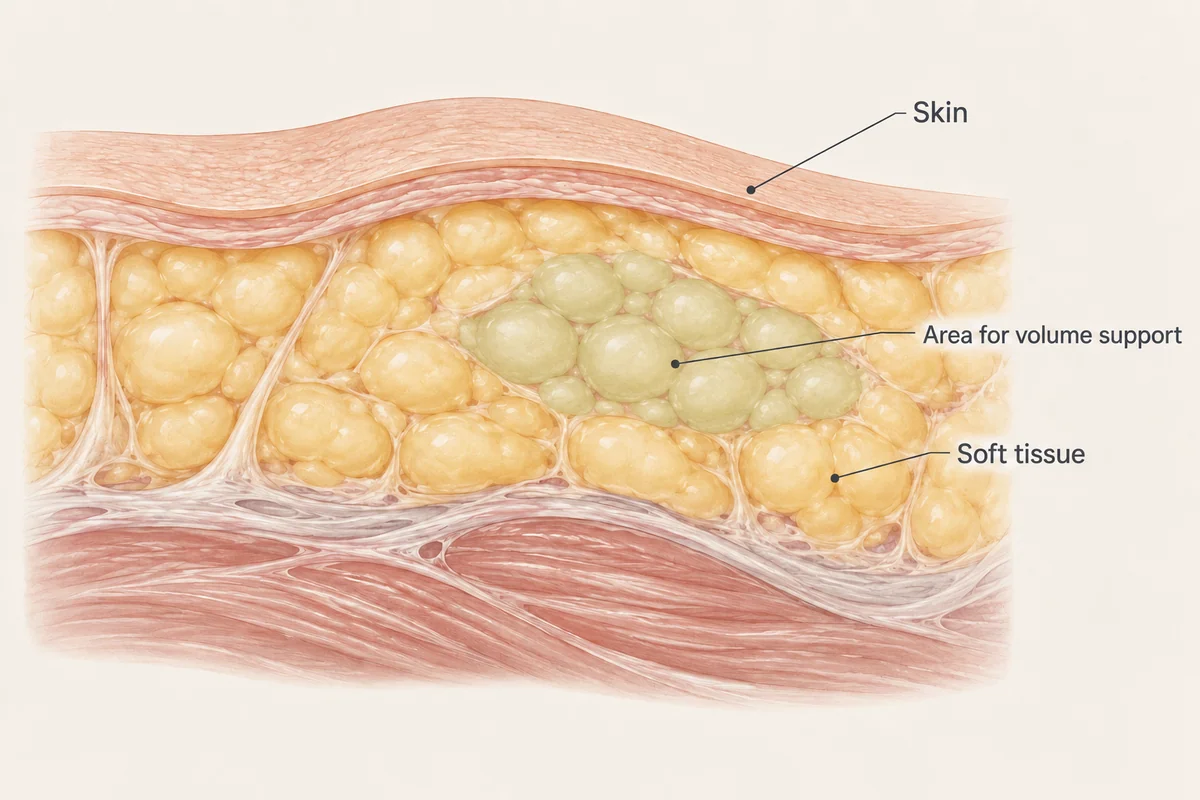
Treatment aims to add soft-tissue volume.
This does not remove excess skin or harvest your own fat.
Potential Treatment Goals
What AlloClae May Help Improve
AlloClae may be considered when the goal is targeted volume or contour improvement rather than a large increase in breast size.
Subtle Breast Volume
Selected patients may use AlloClae to add modest fullness without placing a traditional implant.
Upper-Pole Refinement
Localized placement may improve selected areas of upper-breast deflation or contour transition.
Breast Asymmetry
Different volumes may be placed on each side to improve selected size or shape differences.
Implant Edge Camouflage
Additional soft-tissue coverage may help soften visible or palpable implant edges in appropriately selected patients.
Post-Explant Contour
AlloClae may be considered after implant removal for localized volume loss or contour irregularity.
Revision Refinement
It may support a broader breast revision plan when one localized area needs additional soft-tissue volume or support.
Candidate Overview
Who May Be a Candidate for AlloClae Breast Enhancement?
AlloClae may be considered for healthy adults seeking subtle breast enhancement, contour refinement, or improved symmetry without donor-site liposuction.
It may be especially relevant for patients who have limited donor fat, prefer to avoid traditional implants, or need a focused correction after previous breast surgery.
Candidacy depends on breast health, tissue thickness, skin quality, prior surgery, imaging history, the amount of desired volume, and whether the breast also needs lifting or structural reshaping.
Potential candidates may:
- Want modest rather than dramatic enlargement
- Prefer to avoid traditional breast implants
- Have limited donor fat for fat transfer
- Want to avoid liposuction donor-site recovery
- Need localized contour correction
- Have realistic expectations about volume and longevity
Treatment Process
How AlloClae Breast Augmentation Is Performed
Consultation & Breast Evaluation
Dr. Riccelli evaluates breast shape, tissue thickness, skin quality, symmetry, prior surgery, breast imaging, and the patient’s desired result.
Targeted Treatment Planning
The specific areas needing volume or support are marked so treatment focuses on contour rather than simply adding volume everywhere.
Product Preparation
The structural adipose tissue is prepared according to product instructions and the treatment plan.
Subcutaneous Placement
AlloClae is placed beneath the skin in small, controlled amounts where adipose tissue naturally exists.
Shape and Symmetry Check
Placement is adjusted to improve balance, contour transitions, and the relationship between both breasts.
Customized Combination
AlloClae may be combined with lift, implant exchange, implant removal, or another revision procedure when appropriate.
Marketing Term vs. Medical Reality
Why Is It Called the “Lunchtime Breast Augmentation”?
Some practices use the phrase “lunchtime breast augmentation” because AlloClae does not require donor-site liposuction and may be placed through a less extensive treatment process than surgical augmentation with implants.
The phrase is useful for describing the general concept, but it is not a formal medical procedure name. It should not be interpreted to mean that every patient can be treated during a lunch break, return immediately to full activity, or achieve implant-like enlargement without recovery.
Treatment time, anesthesia, swelling, bruising, activity restrictions, and recovery depend on the amount placed, the number of areas treated, whether another breast procedure is performed, and the patient’s individual response.
Dr. Riccelli presents AlloClae as a focused breast-enhancement option—not a shortcut around appropriate surgical planning.
Comparing Breast Enhancement Options
AlloClae vs. Fat Transfer vs. Breast Implants
These three options are not interchangeable. Each offers a different balance of volume, predictability, donor-site surgery, recovery, and long-term maintenance.
Dr. Riccelli recommends the option that best matches the patient’s anatomy and desired result rather than assuming the newest treatment is automatically the best one.
AlloClae
Ready-to-use donor-derived structural adipose tissue. No donor-site liposuction. Best suited to modest, localized volume and contour refinement.
Traditional Fat Transfer
Uses the patient’s own fat and requires liposuction. Can provide broader natural volume when enough donor fat and recipient tissue are available.
Breast Implants
Provide the most predictable increase in breast size, projection, shape, and upper-pole fullness.
Combination Treatment
Lift, implant, fat grafting, or structural adipose tissue may be combined when one treatment alone cannot address the full breast concern.
Detailed Comparison
Which Option Best Matches Your Goals?
Requires Your Own Donor Fat
AlloClae: No. Fat transfer: Yes. Implants: No.
Requires Liposuction
AlloClae: No. Fat transfer: Yes. Implants: No.
Uses a Traditional Implant
AlloClae: No. Fat transfer: No. Implants: Yes.
Predictable Large Size Increase
AlloClae: Limited. Fat transfer: Limited to moderate. Implants: Most predictable.
Localized Contour Correction
AlloClae: Well suited. Fat transfer: Well suited. Implants: Less targeted.
Best Overall Use
AlloClae: Focused volume. Fat transfer: Natural augmentation plus body contouring. Implants: Predictable augmentation.
AlloClae After Prior Breast Surgery
Using Structural Adipose Tissue for Breast Revision
After Implant Removal
AlloClae may help restore selected areas of volume loss after breast implant removal.
With Implant Exchange
It may provide localized tissue coverage or contour support during implant exchange.
For Rippling or Visible Edges
Selected patients may benefit from added soft-tissue volume over an implant edge or localized rippling.
With Breast Lift
A breast lift may improve position and skin laxity while AlloClae addresses a selected volume deficit.
For Breast Asymmetry
Different amounts may be placed on each side to refine selected asymmetries.
Complex Breast Revision
AlloClae may be one part of a larger breast revision plan involving the implant, pocket, capsule, skin, and breast tissue.
Realistic Expectations
How Much Breast Volume Can AlloClae Create?
AlloClae is generally best for modest, localized enhancement. The amount that can be placed depends on breast anatomy, tissue thickness, skin capacity, treatment area, safety, product volume, and the desired result.
It should not be expected to create the same degree of enlargement, projection, or implant-defined shape as a traditional breast implant.
Some patients may be better candidates for fat transfer when broader natural volume is desired and enough donor fat is available. Others may be better candidates for implants when the goal is a clear increase in cup size or more predictable upper-pole fullness.
Exact cup-size changes cannot be guaranteed. A consultation is necessary to determine whether the desired change is realistic with AlloClae.
AlloClae may be less appropriate when:
- A dramatic increase in breast size is desired
- Major breast sagging requires lifting
- A predictable implant-shaped result is the goal
- There is an unresolved breast-health concern
- The skin or tissues cannot safely support the desired volume
- The patient expects permanent, guaranteed volume
Longevity & Future Treatment
How Long Do AlloClae Results Last?
AlloClae is a relatively new aesthetic treatment, and long-term breast-specific data remain limited. Visible volume can vary by treatment area, amount used, patient anatomy, lifestyle, and tissue response.
Patients should not assume the result is permanent. Additional treatment may be considered in the future if volume decreases, the breasts change with age or weight, or the patient’s goals evolve.
This uncertainty is one reason Dr. Riccelli discusses AlloClae alongside fat transfer and implants rather than presenting it as universally superior.
Breast Imaging & Safety
What Patients Should Know Before Treatment
AlloClae is placed in breast soft tissue, so patients should maintain routine breast-health screening and tell future radiology providers about the treatment.
Any new lump, persistent pain, skin change, nipple discharge, swelling, or other concerning breast symptom should be evaluated rather than assumed to be related to cosmetic treatment.
Patients with unresolved breast symptoms, abnormal imaging, active infection, certain medical conditions, or other contraindications may need additional evaluation before treatment.
Potential risks may include swelling, bruising, tenderness, infection, bleeding, contour irregularity, asymmetry, palpable areas, inflammatory reaction, tissue response, dissatisfaction, or the need for additional treatment. Individual risks are reviewed during consultation.
Recovery
What to Expect After AlloClae Breast Enhancement
Recovery is generally different from traditional fat transfer because no donor-site liposuction is required. However, patients should still expect temporary swelling, tenderness, bruising, tightness, and activity restrictions around the treated breasts.
The amount of downtime depends on the treatment volume, whether one or both breasts are treated, whether another procedure is performed, and the patient’s individual response.
Patients may be advised to limit pressure, strenuous upper-body activity, or exercise during early healing. Dr. Riccelli provides individualized instructions based on the treatment performed.
Early volume may be influenced by swelling. The appearance continues to refine as swelling improves and the tissues settle.
The Ennis Plastic Surgery Team
Collaborative Planning for Advanced Breast Enhancement
Newer treatment options require careful patient selection and honest comparison with established procedures.
Dr. Riccelli works within the established Ennis Plastic Surgery environment alongside Dr. L. Scott Ennis, Donna Ennis, clinical staff, anesthesia professionals, operating-room personnel, and recovery staff.
The team reviews the patient’s breast anatomy, prior procedures, imaging, treatment goals, product requirements, and recovery plan before care is provided.
This collaborative approach supports the practice’s focus on safety, discretion, detailed planning, and personalized treatment.
Tour Ennis Plastic Surgery
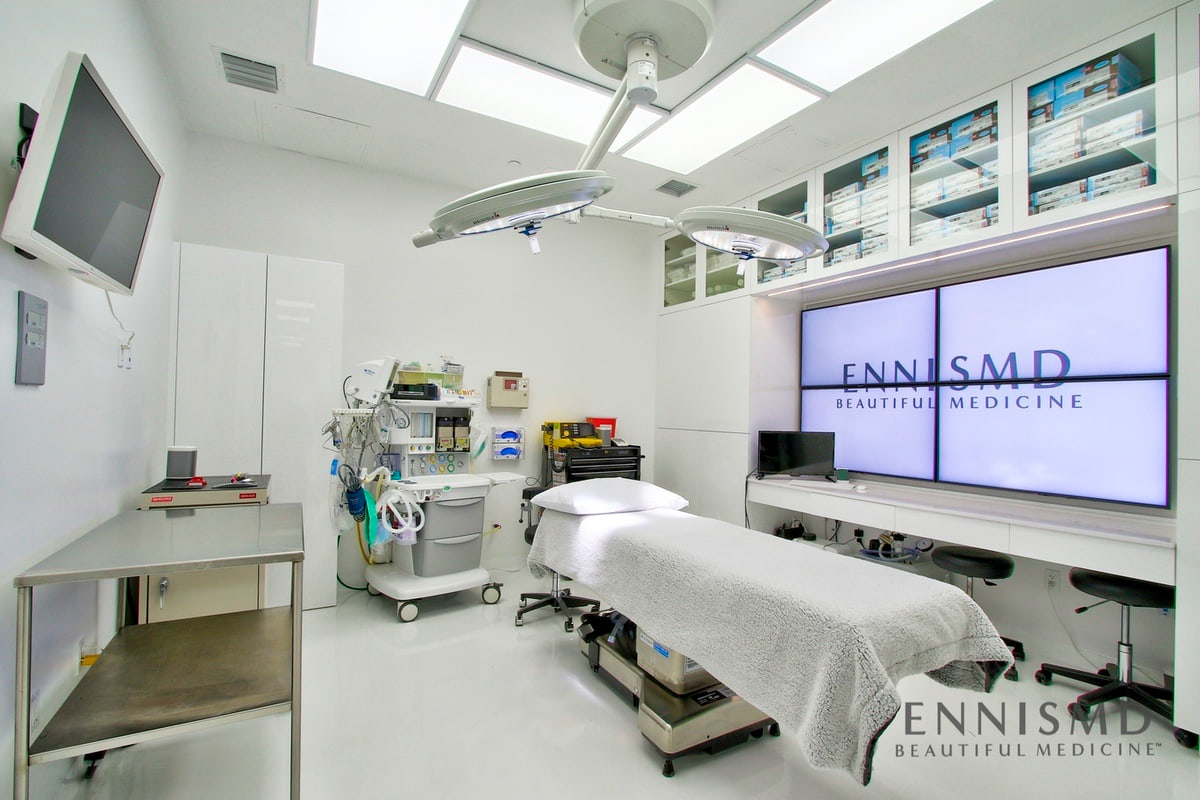
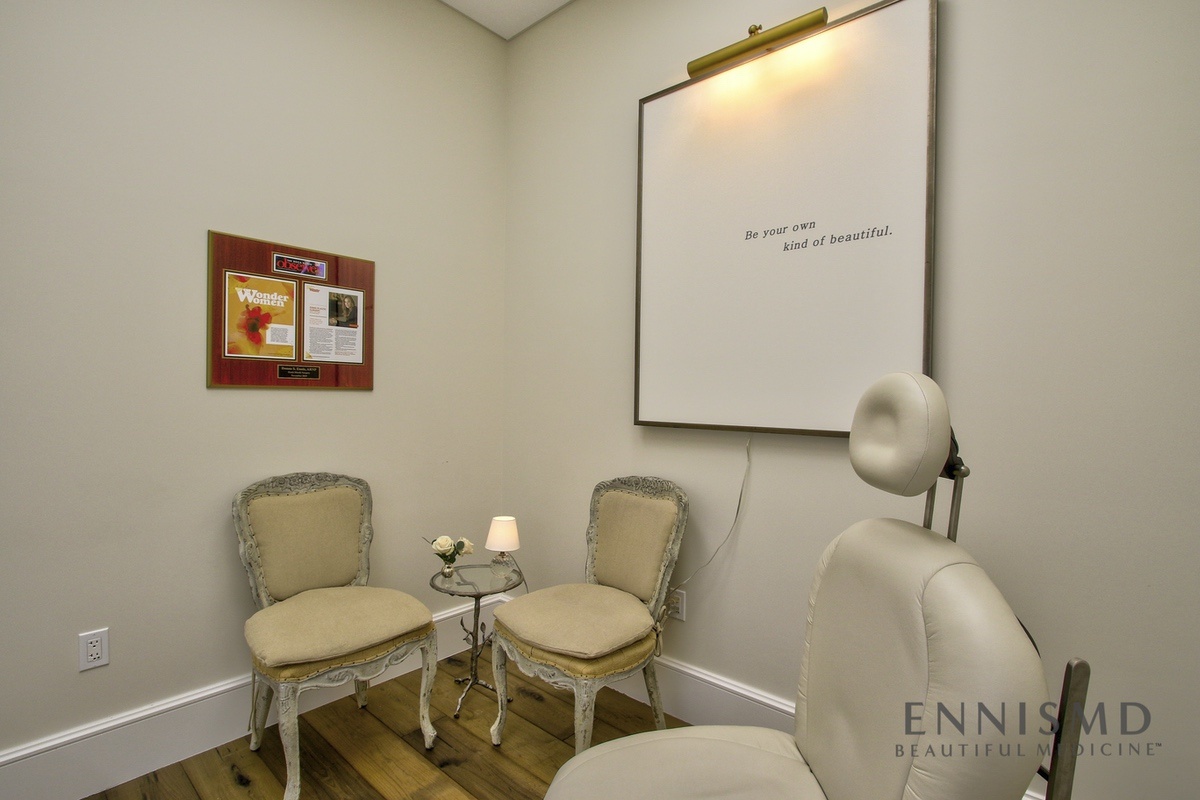
Experience Our Private Boca Raton Surgical Center
Ennis Plastic Surgery was designed to provide a discreet, comfortable, and personalized experience from consultation through recovery.
Explore the practice
- Private patient entry and lobby
- Consultation rooms
- On-site surgical areas
- Post-operative recovery spaces
- Patient checkout and follow-up areas
 Watch the film
Why Ennis Plastic Surgery
AlloClae Breast Enhancement in a Private Breast Revision Practice
Ennis Plastic Surgery combines advanced breast surgery planning, private consultation, implant evaluation, and individualized treatment for patients considering AlloClae, fat transfer, implants, or combination procedures.
The recommendation is based on breast anatomy, tissue thickness, skin quality, imaging history, prior surgery, desired volume, and the patient’s long-term preferences.
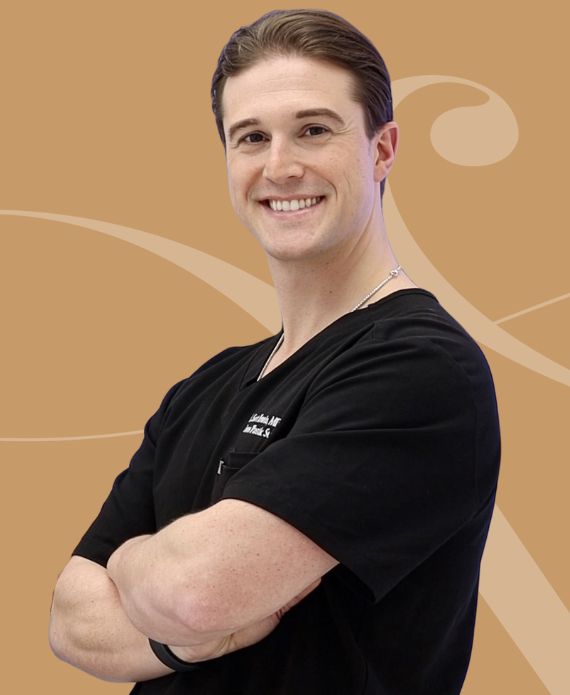
Dr. Vincent Riccelli
Dr. Vincent Riccelli is a plastic surgeon specializing in breast rejuvenation, breast revision surgery, breast implant evaluation, and body contouring.
For AlloClae patients, Dr. Riccelli evaluates breast shape, tissue coverage, symmetry, imaging history, prior surgery, desired volume, and whether lift, implant, fat transfer, or revision surgery would create a more appropriate result.
His approach is built around careful patient selection, honest comparison, natural proportion, safety, and individualized care.
Questions worth asking
Frequently Asked Questions
What is AlloClae?
AlloClae is a ready-to-use structural adipose tissue allograft derived from donated human fat tissue and intended for localized subcutaneous cushioning, support, and volume where adipose tissue naturally exists.
Is AlloClae a breast implant?
No. It is not a traditional breast implant and does not create the same predictable implant-defined volume, projection, or shape.
Is AlloClae the same as fat transfer?
No. Traditional fat transfer uses fat harvested from the patient through liposuction. AlloClae is donor-derived structural adipose tissue supplied ready to use.
What is structural adipose tissue?
Structural adipose tissue preserves elements of the natural architecture and extracellular matrix of fat tissue so it can provide localized cushioning, support, and volume.
Is AlloClae FDA approved for breast augmentation?
AlloClae should not be described as an FDA-approved breast implant. Dr. Riccelli can explain the product’s regulatory status, intended use, and how it is being considered for the proposed treatment during consultation.
How much larger can AlloClae make my breasts?
It is generally intended for modest, localized volume rather than dramatic enlargement. Exact cup-size changes cannot be guaranteed.
Can AlloClae replace breast implants?
Not for every patient. Traditional implants remain more appropriate when a predictable and significant increase in size, projection, or upper-pole fullness is desired.
Can AlloClae replace fat transfer?
It may be an alternative for selected patients who lack donor fat or want to avoid liposuction, but broader natural augmentation may still be better suited to traditional fat transfer.
Who is not a good candidate?
Patients seeking dramatic enlargement, those with unresolved breast-health concerns, active infection, unsuitable tissue support, or unrealistic expectations may not be candidates.
Can AlloClae be used after breast implant removal?
It may be considered for localized volume loss or contour correction after implant removal, although some patients need lift, fat transfer, or staged surgery instead.
Can AlloClae be combined with a breast lift?
Yes. A lift may improve breast position and remove loose skin while AlloClae addresses a selected area of volume deficiency.
Can AlloClae be combined with breast implants?
It may be considered for selected contour concerns, implant-edge visibility, or localized tissue coverage as part of an individualized revision plan.
Can AlloClae improve implant rippling?
Additional soft-tissue volume may help selected cases of visible or palpable implant rippling, but the implant, pocket, tissue thickness, and capsule must also be evaluated.
Can AlloClae improve cleavage?
Localized contour enhancement may improve selected cleavage transitions, but chest anatomy, breast width, implant position, and tissue support limit what can be achieved.
Does AlloClae affect mammograms?
Patients should tell radiology providers about any prior breast tissue treatment. Routine screening should continue, and new breast symptoms should be evaluated.
Is AlloClae the same as Renuva?
No. They are different products with different composition, processing, handling, and intended clinical use.
What is a “lunchtime breast augmentation”?
It is a marketing nickname sometimes used for AlloClae breast enhancement because donor-site liposuction is not required. It does not guarantee implant-like results, no downtime, or immediate return to full activity.
How long is recovery?
Recovery varies with treatment volume and whether another procedure is performed. Temporary swelling, tenderness, bruising, and activity restrictions should be expected.
How long do AlloClae results last?
Long-term breast-specific data remain limited. Visible volume may vary over time, and additional treatment may be considered in the future.
How much does AlloClae breast augmentation cost?
Cost depends on the amount of product, number of treatment areas, facility and anesthesia needs, and whether another breast procedure is performed. A personalized estimate is provided after consultation.
Keep exploring
Understand your options.