
Ennis Plastic Surgery · Beautiful Medicine™
Fat Transfer Breast Augmentation in Boca Raton
Fat transfer breast augmentation uses a patient’s own fat to add subtle volume, soften contour irregularities, improve symmetry, and create a natural-looking enhancement without traditional breast implants.
Explore the ProcedureProcedure at a glance
- Surgeon
- Dr. Vincent Riccelli, MD
- Location
- Boca Raton, Florida
- Focus
- Fat Transfer Breast Augmentation
- Consultation
- In-Office & Virtual
A personal approach
Your consultation
with Dr. Riccelli.
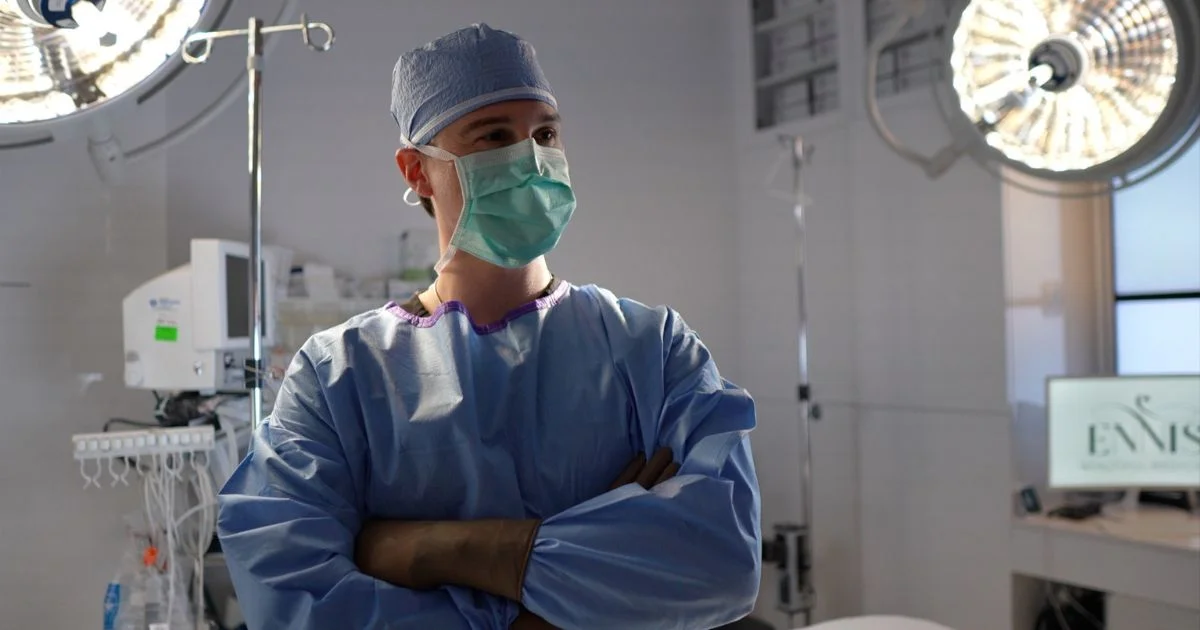
At Ennis Plastic Surgery, Dr. Vincent Riccelli specializes in breast rejuvenation, breast revision, and body contouring. He uses liposuction to collect fat from selected donor areas, prepares that fat for transfer, and places it strategically within the breasts.
This option is best suited to patients seeking a modest increase rather than a dramatic size change. It may be performed alone or combined with a breast lift, implant exchange, implant removal, or another revision procedure.
 Meet Dr. Riccelli
Fat Transfer Breast Augmentation Quick Facts
Natural Volume Using Your Own Fat
Procedure
Liposuction removes fat from selected donor areas, and purified fat is carefully injected into the breasts.
Best For
Patients seeking subtle enhancement, contour refinement, or improved symmetry without traditional implants.
Additional Benefit
Donor areas such as the abdomen, flanks, thighs, or back may also be contoured through liposuction.
May Be Combined With
Breast lift, implant removal, implant exchange, breast revision, or staged breast reshaping.
Understanding the procedure
What Is Fat Transfer to the Breasts?
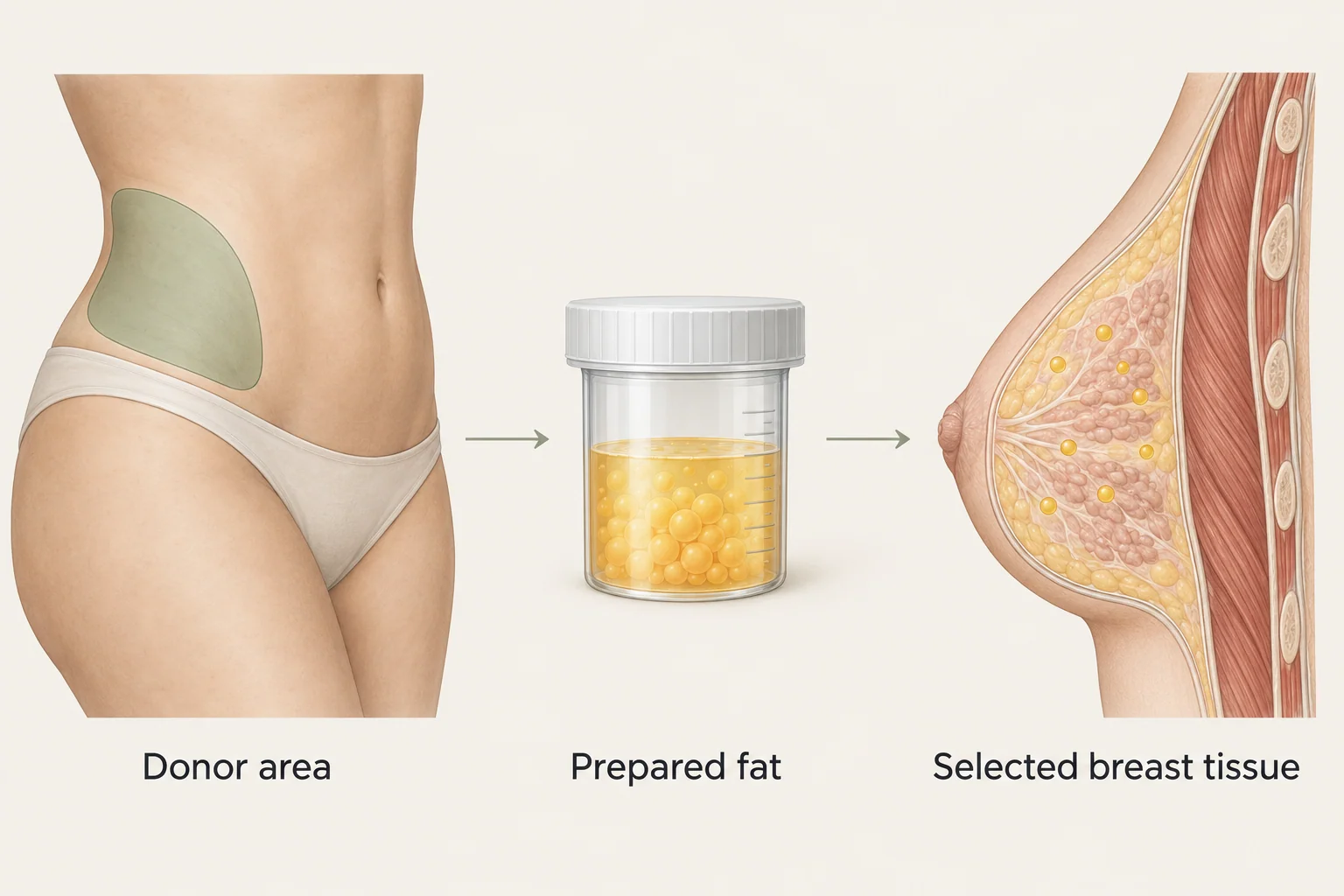
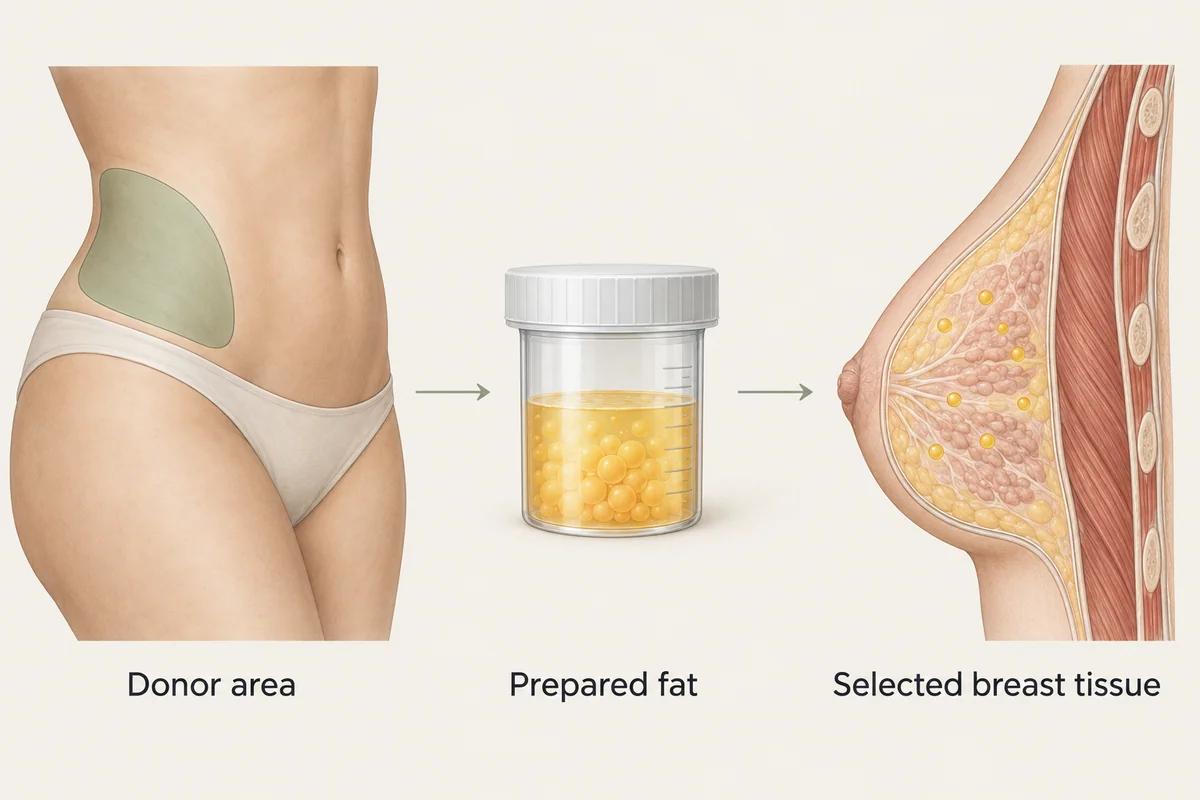
Fat transfer, also called fat grafting, uses fat harvested from another area of the patient’s body. Common donor areas include the abdomen, waist, flanks, thighs, hips, and back.
After the fat is removed with liposuction, it is processed and prepared for transfer. Dr. Riccelli then places small amounts of fat throughout different tissue planes of the breast to improve volume and contour.
The transferred fat must establish a new blood supply to survive. For that reason, fat is placed in small, carefully distributed amounts rather than as one large deposit.
The result is generally more subtle than implant-based augmentation. Fat takes on the shape of the existing breast rather than creating the more predictable structure and projection associated with an implant.

Your own fat is used to add volume
Fat transfer collects fat from a donor area, prepares it, and places it in selected breast tissues. It does not use a breast implant.
Donor fat availability affects the plan.
Not all transferred fat persists after healing.
Potential Benefits
Why Patients Choose Fat Transfer Breast Augmentation
Natural-Looking Enhancement
Transferred fat can provide soft, subtle volume that follows the patient’s existing breast shape.
No Traditional Implant
Patients avoid implant-specific concerns such as rupture, implant exchange, and capsular contracture.
Body Contouring Benefit
Liposuction may improve the contour of the abdomen, flanks, thighs, back, or another donor area.
Improved Symmetry
Different volumes can be placed on each side to address selected breast asymmetry.
Contour Refinement
Fat grafting may soften implant edges, upper-pole hollows, cleavage irregularities, or localized depressions.
Dr. Riccelli’s Goal
Create a balanced, natural result while preserving healthy tissue and realistic expectations about volume.
Candidate Overview
Who Is a Good Candidate?
Good candidates are generally healthy, at a stable weight, have enough donor fat, and want a modest increase in breast volume or improved breast shape.
Patients should understand that fat transfer cannot reliably create the same degree of size increase, projection, or upper-pole fullness as a breast implant.
Very lean patients may not have enough donor fat. Patients with significant breast sagging may need a breast lift in addition to or instead of fat transfer.
Ideal candidates often:
- Want subtle breast enhancement
- Prefer to avoid traditional implants
- Have enough donor fat available
- Are near a stable body weight
- Want improved breast symmetry or contour
- Have realistic expectations about fat survival
Procedure Details
How Fat Transfer Breast Augmentation Works
Donor-Area Planning
Dr. Riccelli identifies areas with enough usable fat and plans liposuction to preserve smooth body contours.
Fat Harvesting
Fat is removed through small incisions using liposuction techniques designed to protect the harvested tissue.
Fat Preparation
The collected fat is processed to separate usable fat tissue from excess fluid, oil, and other material.
Strategic Injection
Small amounts of fat are placed in multiple passes and tissue planes to support integration and smooth contour.
Symmetry Check
The breasts are compared throughout the procedure, and placement is adjusted for shape and balance.
Two Treatment Areas
Recovery involves both the breast injection sites and the areas treated with liposuction.
Newer Non-Implant Option
AlloClae and the “Lunchtime Breast Augmentation”
AlloClae is a newer, ready-to-use structural adipose tissue product derived from donated human fat tissue. It is designed for placement beneath the skin in areas where adipose tissue naturally exists to provide cushioning, volume, and support.
Because it does not require liposuction to harvest the patient’s own fat, some practices refer to breast enhancement with AlloClae as a “lunchtime breast augmentation.” This is a marketing nickname, not a promise that the treatment is equivalent to traditional breast augmentation or that every patient can return immediately to normal activity.
AlloClae may be considered for selected patients seeking localized breast contour improvement, modest volume, improved symmetry, or refinement after implant removal or revision. It may also provide an option for patients who do not have enough donor fat for traditional fat transfer.
It is not a breast implant and does not create the same predictable volume, shape, or projection as implant-based augmentation. Candidacy, appropriate placement, expected longevity, cost, and potential risks must be reviewed with Dr. Riccelli.
AlloClae may appeal to patients who:
- Want modest, localized enhancement
- Prefer to avoid traditional implants
- Do not have enough donor fat
- Want no liposuction donor-site recovery
- Need contour refinement or symmetry correction
- Understand that results differ from implants
Comparing Your Options
Fat Transfer vs. AlloClae vs. Breast Implants
Each option offers a different balance of volume, predictability, recovery, donor-site requirements, and long-term maintenance.
Dr. Riccelli helps patients choose based on anatomy and desired outcome rather than selecting a treatment because it is newer or more familiar.
Fat Transfer
Uses the patient’s own fat and includes liposuction. Best for modest enhancement and natural contouring.
AlloClae
Uses ready-to-use structural adipose tissue without harvesting donor fat. Intended for localized volume and support.
Breast Implants
Provide the most predictable increase in volume, projection, and implant-defined breast shape.
Combination Approach
Implants, fat grafting, lift, or revision techniques may be combined when one method alone cannot create the desired result.
Volume & Fat Survival
How Much Breast Enlargement Is Realistic?
Fat transfer usually provides a subtle increase in breast volume. The amount depends on available donor fat, breast tissue capacity, skin tightness, blood supply, and how much fat survives after transfer.
Not all transferred fat survives permanently. Some volume is naturally absorbed during healing, so the early postoperative appearance is fuller than the long-term result.
Some patients may benefit from more than one treatment session to build additional volume gradually. Dr. Riccelli avoids placing excessive fat in one session because overcrowding the tissue can reduce fat survival and increase the risk of oil cysts, fat necrosis, or irregularity.
Exact cup-size changes and retention percentages cannot be guaranteed.
Combination Procedures
Fat Transfer with Breast Lift, Revision, or Implant Removal
With Breast Lift
A lift improves position and removes loose skin, while fat transfer can restore selected volume and contour.
After Implant Removal
Fat transfer may restore limited volume or soften contour changes after breast implant removal.
With Implant Exchange
Fat can soften implant edges, improve tissue coverage, and refine cleavage during implant exchange.
For Breast Asymmetry
Different volumes may be used on each side to improve selected size or contour differences.
For Revision Irregularities
Fat may help soften depressions, visible implant edges, or localized tissue deficiencies after prior surgery.
Staged Treatment
More than one procedure may be recommended when tissue quality or desired volume limits a single-session result.
Breast Imaging & Safety
What Patients Should Know About Lumps, Cysts & Mammograms
Fat grafting can create oil cysts, fat necrosis, calcifications, or firm areas within the breast. These changes are often benign but may be visible on mammography, ultrasound, or MRI.
Patients should continue routine breast screening based on age, history, and medical recommendations. It is important to tell the radiologist about prior fat grafting or structural adipose tissue placement.
A new lump, persistent pain, skin change, nipple discharge, or other concerning symptom should be evaluated rather than assumed to be related to prior cosmetic treatment.
Fat transfer is not appropriate for every patient. Dr. Riccelli reviews personal and family history, prior imaging, breast health, and the need for additional medical evaluation before surgery.
Recovery & Results
What to Expect After Breast Fat Transfer
Recovery involves both the breasts and the liposuction donor areas. Patients can expect swelling, bruising, soreness, and tightness in both locations.
Compression garments may be used on the liposuction areas, while pressure directly on the breasts may be limited during early healing to protect transferred fat.
Many patients return to light work and routine activity within approximately one week, but timing depends on the amount of liposuction and the procedures performed. Exercise and strenuous activity are restricted longer.
Breast volume decreases as swelling resolves and some transferred fat is absorbed. The retained fat behaves like other living fat in the body and can change with weight gain, weight loss, pregnancy, and aging.
The Ennis Plastic Surgery Team
Collaborative Planning for Breast & Body Contouring
Fat transfer breast augmentation involves both breast surgery and liposuction planning. Careful coordination helps protect breast shape while creating smooth donor-area contours.
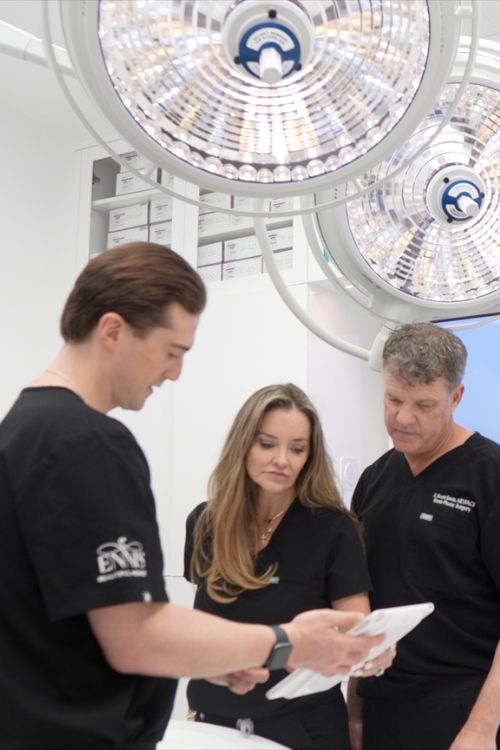
Dr. Riccelli works within the established Ennis Plastic Surgery environment alongside Dr. L. Scott Ennis, Donna Ennis, anesthesia professionals, operating-room staff, and recovery personnel.
The team reviews the breast plan, donor areas, expected volume, surgical positioning, recovery needs, and patient goals before treatment.
Tour Ennis Plastic Surgery
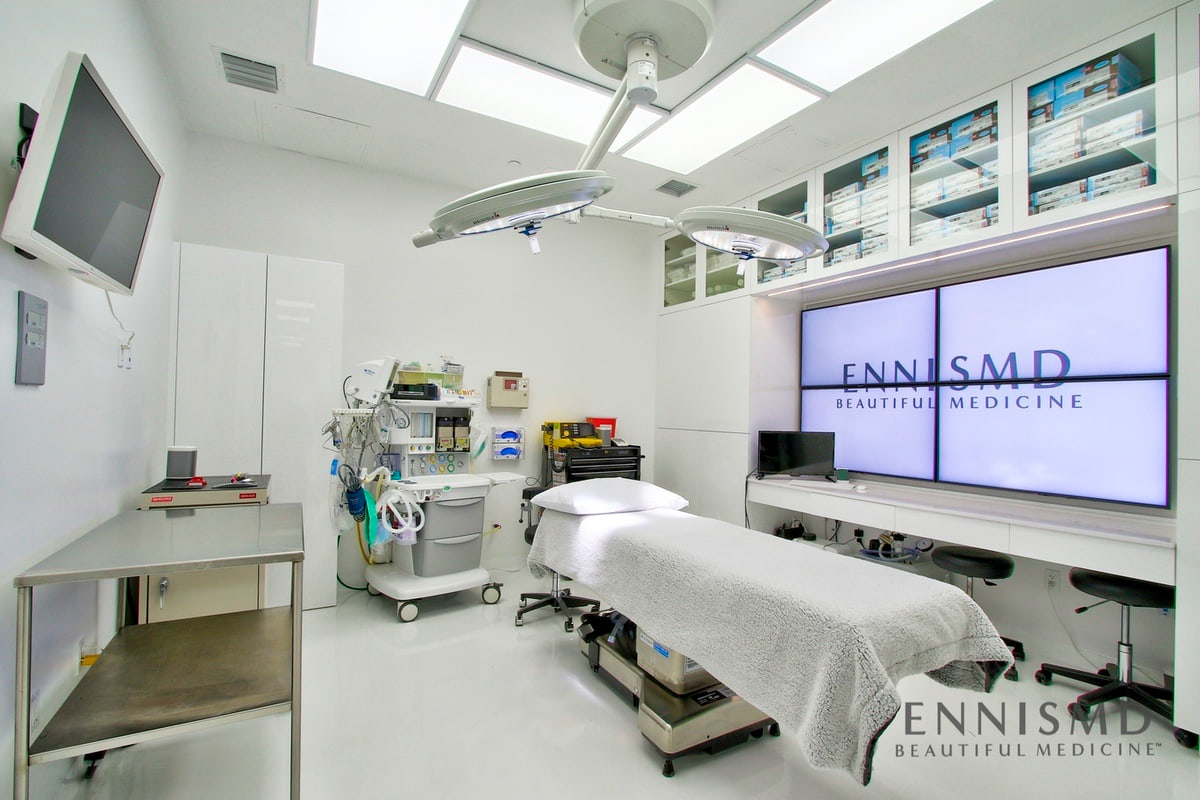
Experience Our Private Boca Raton Surgical Center
Ennis Plastic Surgery was designed to provide a discreet, comfortable, and personalized experience from consultation through recovery.
Explore the practice
- Private patient entry and lobby
- Consultation rooms
- On-site surgical areas
- Post-operative recovery spaces
- Patient checkout and follow-up areas
 Watch the film

Why Ennis Plastic Surgery
Natural Breast Enhancement in a Private Surgical Practice
Ennis Plastic Surgery combines breast surgery, body contouring, private consultation, and individualized planning for patients considering fat transfer, AlloClae, implants, or a combination approach.
Treatment is selected based on breast anatomy, available donor fat, skin quality, desired volume, imaging history, and the patient’s long-term preferences.
Dr. Vincent Riccelli
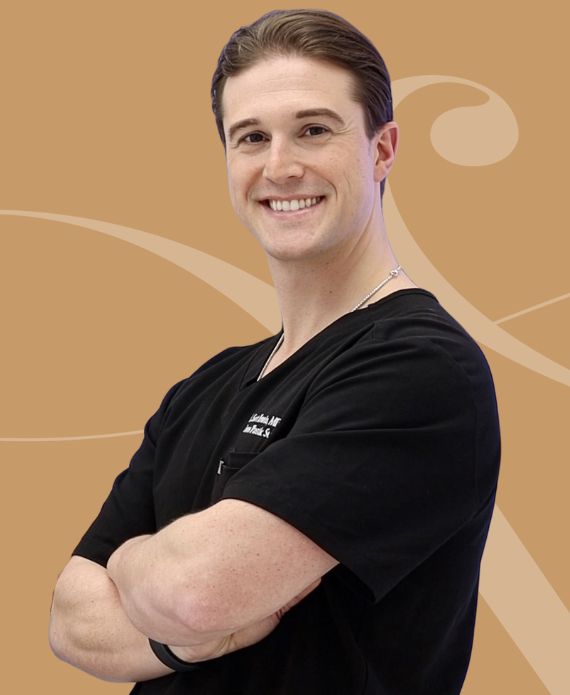
Dr. Vincent Riccelli is a plastic surgeon specializing in breast rejuvenation, breast revision surgery, fat grafting, and body contouring.
For fat transfer patients, Dr. Riccelli evaluates breast shape, tissue thickness, donor-fat availability, skin quality, symmetry, imaging history, and whether lift, implant, or revision surgery should be included.
His approach is built around natural proportion, careful fat placement, realistic expectations, safety, and individualized care.
Questions worth asking
Frequently Asked Questions
What is fat transfer breast augmentation?
Fat transfer breast augmentation uses liposuction to collect a patient’s own fat and strategically injects that fat into the breasts for subtle volume and contour enhancement.
How much larger can my breasts become?
Fat transfer generally creates a modest increase. The amount depends on donor fat, breast tissue capacity, skin quality, and how much transferred fat survives.
Can fat transfer replace breast implants?
It can be an alternative for patients seeking subtle enhancement, but it does not provide the same predictable volume, projection, or shape as an implant.
Where is the fat taken from?
Common donor areas include the abdomen, waist, flanks, thighs, hips, and back, depending on available fat and body-contouring goals.
Does all transferred fat survive?
No. Some transferred fat is naturally absorbed. Exact retention cannot be guaranteed.
Will I need more than one session?
Some patients benefit from staged fat-transfer sessions when they want more volume than can safely be placed in one procedure.
Can fat transfer correct breast asymmetry?
It may improve selected size or contour differences by placing different amounts of fat in each breast.
Can fat transfer be combined with a breast lift?
Yes. A lift can improve breast position and skin laxity while fat transfer restores selected volume.
Can fat transfer be used after implant removal?
Yes. It may provide subtle volume restoration or contour refinement after explant surgery in appropriately selected patients.
What is AlloClae?
AlloClae is a ready-to-use structural adipose tissue product derived from donated human fat tissue and intended for localized subcutaneous cushioning, volume, and support.
What is a “lunchtime breast augmentation”?
The phrase is a marketing nickname sometimes used for localized breast enhancement with AlloClae because donor-site liposuction is not required. It is not equivalent to traditional breast augmentation and does not guarantee no downtime.
Can fat transfer affect mammograms?
Fat grafting may create benign oil cysts, calcifications, or fat necrosis visible on breast imaging. Patients should inform their radiology team about prior treatment.
Keep exploring
Understand your options.