
Ennis Plastic Surgery · Beautiful Medicine™
Areola Reduction in Boca Raton
Areola reduction surgery is designed to reduce the diameter of enlarged or disproportionate areolas and create a more balanced relationship between the areola, nipple, breast shape, and overall chest.
Explore the ProcedureProcedure at a glance
- Surgeon
- Dr. Vincent Riccelli, MD
- Location
- Boca Raton, Florida
- Focus
- Areola Reduction
- Consultation
- In-Office & Virtual
A personal approach
Your consultation
with Dr. Riccelli.
At Ennis Plastic Surgery, Dr. Vincent Riccelli specializes in breast rejuvenation and breast revision surgery. He performs areola reduction as a stand-alone procedure or combines it with a breast lift, breast reduction, implant exchange, implant removal, or other breast reshaping procedure when appropriate.
The goal is not to create one “ideal” areola size. It is to improve proportion, symmetry, and shape while preserving a natural appearance that fits the patient’s breast anatomy and personal goals.
 Meet Dr. Riccelli
Areola Reduction Quick Facts
Focused Breast Reshaping for Improved Proportion
Procedure
Reduces the diameter of the darker skin surrounding the nipple and refines areola shape and symmetry.
Best For
Patients bothered by enlarged, stretched, uneven, oval, or disproportionate areolas.
Can Be Combined With
Breast lift, breast reduction, implant exchange, implant removal, augmentation, or other breast revision surgery.
Recovery
Most patients experience temporary swelling, tenderness, and activity restrictions during early healing.
Understanding the procedure
What Is the Difference Between the Nipple and Areola?
The nipple and areola are separate structures. The nipple is the projecting central portion of the breast. The areola is the circular or oval area of darker skin surrounding the nipple.
Areola reduction changes the diameter and shape of the pigmented skin surrounding the nipple. It does not automatically reduce the projection or length of the nipple itself.
Patients concerned about nipple size or projection may need a separate nipple reduction procedure. In selected cases, nipple and areola reduction can be performed together.
The consultation should identify exactly which feature is causing concern. This helps avoid recommending an areola procedure when the patient’s primary concern is nipple projection, breast sagging, asymmetry, or another issue.

Common Reasons for Treatment
Why Patients Consider Areola Reduction
Areola size and shape vary naturally, and there is no single correct appearance. Surgery is considered when the patient feels that the areola is out of proportion with the breast or has changed in a way that affects confidence.
Naturally Large Areolas
Some patients have always felt their areolas occupy too much of the breast surface or look out of proportion with their breast size.
Changes After Pregnancy
Pregnancy and breastfeeding can enlarge, darken, stretch, or alter the shape of the areolas.
Weight Changes
Breast enlargement and subsequent weight loss may leave the areolas stretched even after breast volume decreases.
Areola Asymmetry
One areola may be larger, higher, lower, rounder, or more oval than the other.
Changes After Surgery
Prior augmentation, lift, reduction, or revision surgery may leave the areolas stretched or uneven.
Dr. Riccelli’s Goal
Create smaller, more balanced areolas that fit the patient’s breast shape and look natural rather than overly reduced.
Candidate Overview
Who Is a Good Candidate for Areola Reduction?
Good candidates are generally healthy, have realistic expectations, and are consistently bothered by the size, shape, or asymmetry of one or both areolas.
Candidacy also depends on skin quality, breast shape, nipple position, prior surgery, pregnancy plans, and whether areola enlargement is part of a broader breast concern.
If the breasts also sag or the nipples sit too low, a breast lift may create a better result than areola reduction alone.
Ideal candidates often want to improve:
- Large areola diameter
- Areola asymmetry
- Oval or irregular areola shape
- Stretching after pregnancy or weight change
- Areola changes after prior breast surgery
- Proportion between the areola and breast

Procedure Illustration
How Areola Reduction Surgery Works
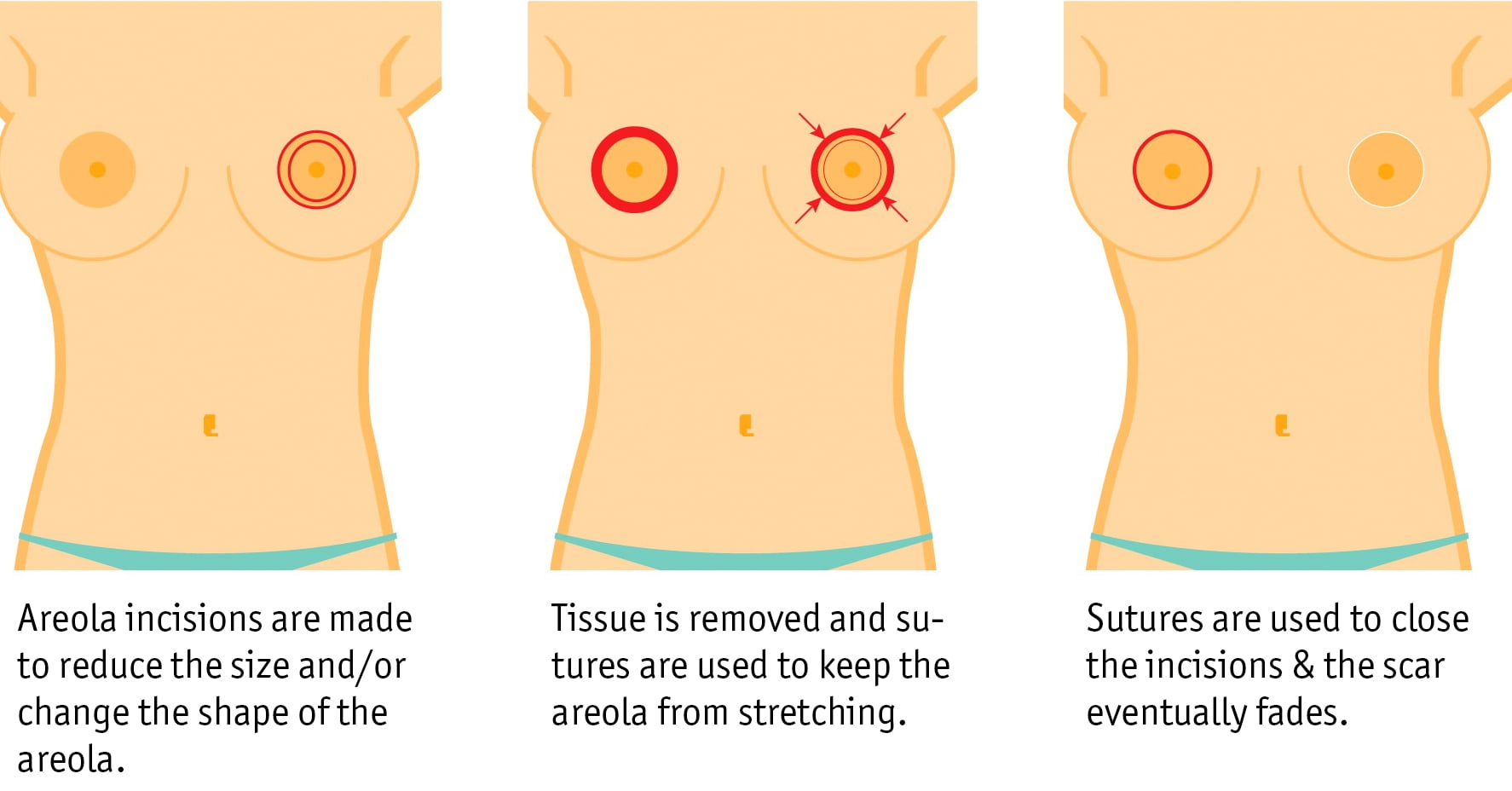
Dr. Riccelli begins by marking the desired areola diameter and confirming symmetry between the two breasts. A ring of excess pigmented skin is then removed from around the outer edge of the areola.
The surrounding skin is brought inward and secured with sutures. This reduces the overall diameter and may provide a mild tightening effect around the central breast.
The procedure must balance reduction with tension. If the areola is made too small or the closure is placed under excessive tension, the scar may widen or the areola may stretch again over time.
Precise marking and tension control are central to a refined result.
Procedure Details
What to Expect During Areola Reduction
Consultation & Planning
Dr. Riccelli evaluates areola diameter, shape, symmetry, nipple position, breast shape, skin quality, and prior surgical history.
Precise Marking
The desired areola size and symmetry are marked before surgery to guide tissue removal.
Skin Removal
A carefully measured ring of excess areola skin is removed while preserving the central nipple-areola structure.
Layered Closure
Sutures are placed to reduce tension, support the new diameter, and create a smoother transition between areola and breast skin.
Symmetry Check
Both sides are compared carefully, although perfect symmetry cannot be guaranteed.
Customized Combination
The procedure may be combined with lift, reduction, implant exchange, implant removal, or other breast revision when appropriate.
Scars & Long-Term Shape
Understanding Areola Reduction Scars
The incision is generally placed around the edge of the areola, where the darker pigmented skin meets the lighter breast skin. This helps the scar blend into the natural color transition.
Scars are permanent but usually fade over time. Scar quality varies according to genetics, healing, skin tension, sun exposure, and postoperative care.
Factors that may affect the result:
- Skin elasticity and tissue quality
- Amount of diameter reduction
- Tension on the closure
- Pregnancy and breastfeeding
- Weight fluctuations
- Natural aging and breast stretching
Some areolas may gradually stretch again. Dr. Riccelli discusses this possibility during consultation and plans the reduction conservatively.
Combination Procedures
Areola Reduction with Other Breast Surgery
Areola reduction is frequently performed as part of a broader breast procedure because pregnancy, weight loss, aging, implants, and prior surgery can affect more than areola diameter alone.
With Breast Lift
A lift can elevate the breast and nipple while areola reduction improves diameter and proportion.
With Breast Reduction
Breast reduction commonly includes areola resizing as part of reducing and reshaping the breast.
With Implant Exchange
Areola enlargement or asymmetry may be corrected during implant exchange when broader revision is needed.
With Implant Removal
After implant removal, areola reduction may be combined with lift surgery to improve shape and position.
With Nipple Reduction
Patients bothered by both areola diameter and nipple projection may consider combined nipple and areola treatment.
With Breast Revision
Areola size, symmetry, scars, implant position, and breast shape can be addressed together during breast revision surgery.
Recovery & Results
What to Expect After Areola Reduction Surgery
Recovery is usually more limited than recovery from a full breast lift or reduction when areola reduction is performed alone. Patients can expect temporary swelling, tenderness, bruising, tightness, and sensitivity around the incision.
Dressings or a supportive bra may be recommended. Most patients can return to light work and routine daily activity within several days, depending on comfort and the extent of surgery.
Strenuous exercise, heavy lifting, friction, and pressure on the breasts should be avoided until Dr. Riccelli confirms that the incision is healing appropriately.
Early scars may look pink, raised, or firm. They generally soften and fade over time. Final areola shape and scar maturation develop gradually over several months.
Areola reduction results may include:
- Smaller areola diameter
- Improved left-to-right symmetry
- A rounder, more balanced shape
- Better proportion with the breast
- Improved appearance after pregnancy or weight loss
- Greater comfort with breast appearance
A Private Consultation Experience
Discussing a Personal Breast Concern with Confidence
Concerns about areola size or shape can feel highly personal. Patients should be able to discuss them in a respectful, private setting without feeling rushed or judged.
At Ennis Plastic Surgery, consultation focuses on understanding what the patient sees, what she would like to change, and whether a focused procedure can achieve that goal.
Dr. Riccelli also explains whether the concern is isolated to the areola or connected to breast sagging, implant changes, nipple projection, or another issue that may require broader planning.

Why Ennis Plastic Surgery
Areola Reduction in a Boutique Surgical Setting
Ennis Plastic Surgery provides private, personalized breast surgery care in a Boca Raton setting designed around comfort, discretion, and refined aesthetic planning.
Even a focused procedure such as areola reduction requires careful attention to size, symmetry, scar placement, skin tension, breast shape, and long-term proportion.
Dr. Vincent Riccelli
Dr. Vincent Riccelli is a plastic surgeon specializing in breast rejuvenation, breast revision surgery, and body contouring. His training includes Vanderbilt University School of Medicine, plastic surgery residency at UT Southwestern, and advanced international exposure to aesthetic surgery techniques.
For areola reduction patients, Dr. Riccelli evaluates areola size, nipple position, breast shape, skin quality, symmetry, previous surgery, and the patient’s desired result.
His approach is built around precision, proportion, discretion, safety, and individualized care.

Questions worth asking
Frequently Asked Questions
What is areola reduction surgery?
Areola reduction removes a measured ring of pigmented skin to reduce the diameter and improve the shape or symmetry of the areola.
What is the difference between areola reduction and nipple reduction?
Areola reduction changes the darker skin surrounding the nipple. Nipple reduction changes the projection, width, or length of the central nipple itself.
Is there a normal areola size?
Areola size varies widely, and there is no single correct size. Surgery is considered when the patient feels the areola is disproportionate to the breast or is consistently bothered by its appearance.
Can areola reduction improve asymmetry?
Yes. Surgery may improve differences in diameter or shape, although perfect symmetry cannot be guaranteed.
Will the scar be visible?
The scar is placed around the edge of the areola and may blend into the color transition between areola and breast skin. It is permanent but generally fades over time.
Can the areola stretch again after surgery?
Yes. Pregnancy, breastfeeding, weight change, skin tension, aging, and breast stretching can enlarge the areola again over time.
Can areola reduction be done without a breast lift?
Yes, when areola size is the primary concern and breast position is otherwise acceptable. A lift may be recommended when sagging or low nipple position is also present.
Can areola reduction be combined with breast augmentation?
Yes. It may be combined with augmentation, implant exchange, lift, reduction, implant removal, or another breast revision procedure when appropriate.
Will areola reduction affect nipple sensation?
Temporary sensation changes are possible. Permanent changes are less common but can occur with any breast or nipple-areola surgery.
Can areola reduction affect breastfeeding?
It may affect breastfeeding depending on the technique and whether other breast procedures are performed. Patients with future breastfeeding goals should discuss them during consultation.
How long is recovery?
Many patients return to light work within several days after an isolated areola reduction. Strenuous activity is restricted until the incisions have healed sufficiently.
Are virtual consultations available?
Virtual consultations may be available for an initial discussion, especially for out-of-town patients. An in-person examination is required before final surgical planning.
Keep exploring
Understand your options.