

Breast Implant Removal & Capsulectomy in Boca Raton
En Bloc Explant & Capsulectomy with Dr. Vincent Riccelli
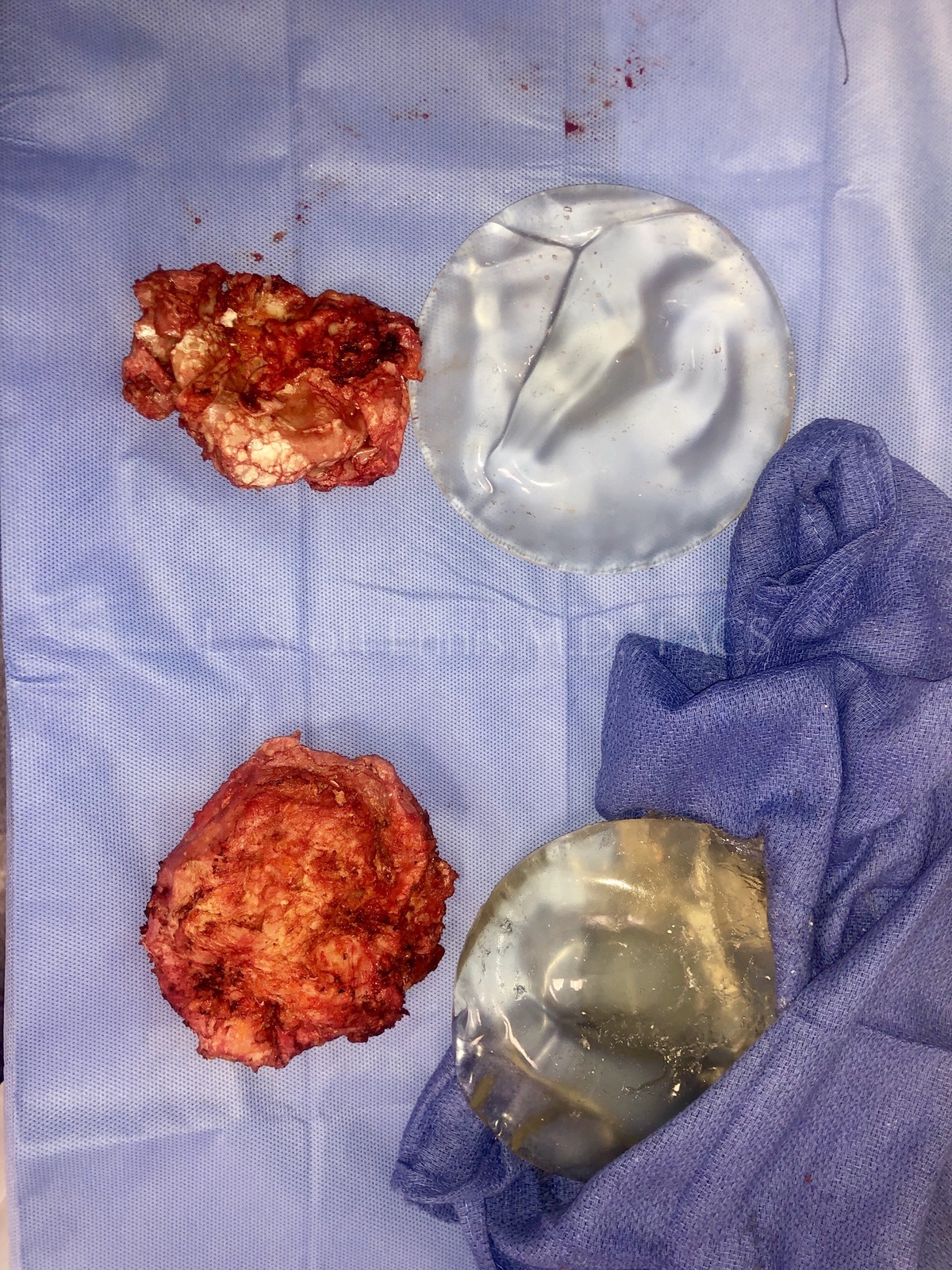
Patients researching breast implant removal often encounter the phrase “en bloc.” The term is frequently used online, but it describes a specific surgical approach and is not the correct or safest procedure for every implant-removal patient.
At Ennis Plastic Surgery, Dr. Vincent Riccelli specializes in breast revision, implant removal, and capsulectomy. He evaluates the implant, capsule, symptoms, imaging, breast tissue, prior surgery, and patient goals before recommending implant removal alone, partial capsulectomy, total capsulectomy, intact capsule removal when safely possible, or true en bloc resection when medically indicated.
The priority is not using the most aggressive-sounding term. The priority is selecting the safest operation that addresses the actual implant and capsule problem while protecting the chest wall, ribs, muscles, lungs, breast tissue, and blood supply.
Explant & Capsulectomy Quick Facts
Understanding the Implant, Capsule & Surgical Options
Implant Removal
The breast implant is removed, with capsule treatment selected according to findings and medical need.
Capsulectomy
Removal of part or all of the scar-tissue capsule that naturally forms around an implant.
True En Bloc Resection
Removal of the capsule with a margin of surrounding tissue, generally reserved for suspected or confirmed implant-associated malignancy.
May Be Combined With
Breast lift, fat transfer, implant exchange, pocket repair, or staged breast reshaping.
Current Surgical Terminology
What Does “En Bloc” Actually Mean?
A breast implant is surrounded by a capsule of scar tissue created by the body. During some removal procedures, the surgeon may be able to remove the implant while leaving the capsule intact around it. This is commonly described online as “en bloc,” but current surgical terminology is more specific.
True en bloc capsulectomy means removing the implant capsule with a margin of uninvolved surrounding tissue. It is generally used when treating suspected or established implant-associated cancer after an appropriate medical workup.
When an implant and the entire capsule are removed together without an additional margin of healthy tissue, the more accurate term is often intact total capsulectomy. When the entire capsule is removed but not necessarily in one intact piece, the procedure is a total capsulectomy.
Other patients may need only part of the capsule removed, or no capsule removal at all. Dr. Riccelli explains the recommended operation in clear terms so the patient understands exactly what is planned and why.
Meet Dr. Vincent Riccelli
Learn more about Dr. Riccelli’s training and personalized approach to breast revision, implant removal, capsulectomy, and body contouring.
Capsulectomy Options
Not Every Implant Removal Requires the Same Capsule Surgery
The capsule may be thin and harmless, thick and contracted, ruptured, calcified, inflamed, or closely attached to the chest wall. The appropriate operation depends on those findings.
Implant Removal Alone
The implant is removed while most or all of a thin, non-problematic capsule is left in place.
Partial Capsulectomy
Selected areas of abnormal, thickened, calcified, or symptomatic capsule are removed.
Total Capsulectomy
The surgeon removes the entire capsule, although it may need to be removed in more than one piece.
Intact Total Capsulectomy
The implant and full capsule are removed together without intentionally opening the capsule, when safely achievable.
True En Bloc Capsulectomy
The capsule is removed with a margin of uninvolved tissue, generally in the setting of suspected or confirmed implant-associated malignancy.
Customized Surgical Judgment
Dr. Riccelli selects the least invasive operation that safely addresses the implant, capsule, symptoms, and medical findings.
Implant Evaluation
Complimentary AI-Assisted Breast Implant Screening
Patients considering explant surgery may have concerns about rupture, firmness, pain, asymmetry, implant aging, or changes in breast shape.
Dr. Riccelli offers complimentary AI-assisted breast implant ultrasound screening as part of an implant evaluation consultation. Ultrasound may provide useful information about implant integrity and surrounding tissues.
If the findings are unclear or there are symptoms requiring formal diagnostic evaluation, additional imaging or referral to an appropriate specialist may be recommended.
Possible Indications
When Capsule Removal May Be Considered
Capsular Contracture
Thick, tightened scar tissue may cause firmness, pain, implant elevation, or visible breast distortion.
Ruptured Silicone Implant
Capsule removal may help address silicone gel contained within or around the capsule, depending on rupture findings.
Calcified or Abnormal Capsule
Thickened, calcified, inflamed, or otherwise abnormal capsule tissue may warrant partial or total removal.
Implant-Associated Malignancy
Suspected or confirmed implant-associated cancer requires specialized diagnostic workup and oncologic surgical planning.
Textured Implant Concerns
Capsule management is individualized according to symptoms, implant type, imaging, medical guidance, and patient preference.
Symptoms with Existing Implants
Patients reporting systemic or breast symptoms receive a broad evaluation because implants may not be the only possible cause.
Clinical Surgical Example
Ruptured Implant and Capsule Removal
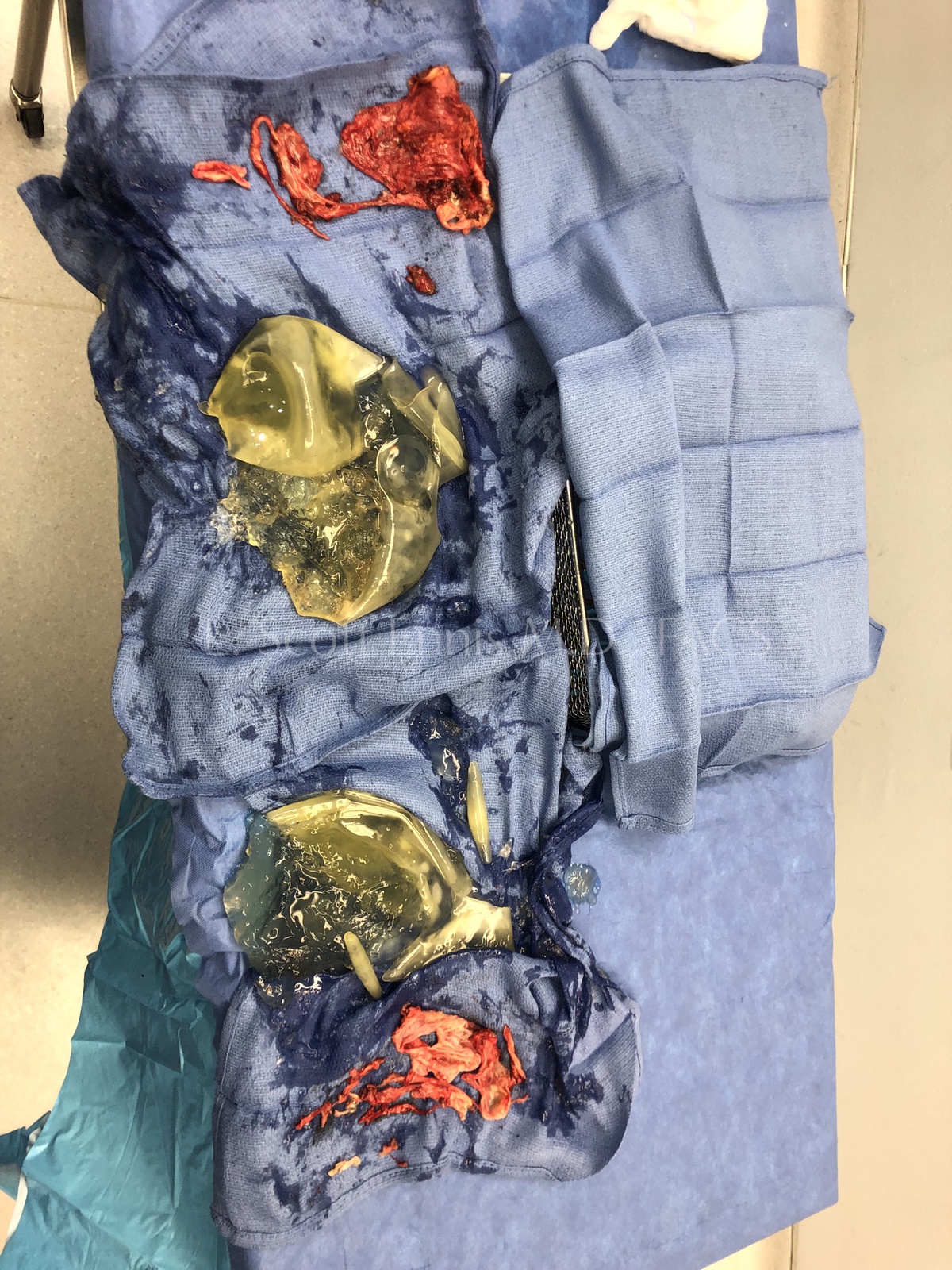
A ruptured silicone implant may be contained within the capsule or may involve silicone outside the implant shell. The operative plan depends on imaging, symptoms, implant age, capsule anatomy, and what is found during surgery.
When possible and safe, maintaining the capsule around a ruptured implant during removal may help limit contact between implant contents and surrounding tissues. However, the capsule may be fragile, adherent, previously disrupted, or impossible to remove intact.
Patients should understand that a surgeon cannot ethically guarantee intact removal before the operation. Safety takes priority over preserving the capsule as one piece.
Learn more about evaluation and treatment on the ruptured breast implant guide.
Breast Implant Illness & Systemic Symptoms
What Patients Should Understand About Symptom Improvement
Some patients with breast implants report fatigue, joint pain, brain fog, rashes, hair changes, anxiety, or other systemic symptoms commonly described as breast implant illness.
These symptoms are real and deserve respectful evaluation. However, they can have many potential causes, and there is no single diagnostic test that proves breast implants are responsible in an individual patient.
Important expectations:
- Some patients report improvement after implant removal
- Improvement cannot be guaranteed
- Other medical causes should be evaluated
- Total capsulectomy is not proven necessary for symptom improvement in every patient
- More extensive surgery carries additional risk
- The operation should match the clinical indication
Dr. Riccelli discusses the available evidence, the limits of current knowledge, and the expected surgical tradeoffs without dismissing the patient’s concerns or promising a cure.
Surgical Safety
Why Complete Capsule Removal Is Not Always Safest
The back wall of the implant capsule may sit directly against the ribs, intercostal muscles, chest wall, or the thin tissue separating the chest from the lung. Attempting to remove every millimeter can increase surgical risk.
Bleeding
Capsule dissection can involve blood vessels within the breast, muscle, and chest-wall tissues.
Chest-Wall Injury
Dense capsule may adhere closely to muscle, ribs, or surrounding structures.
Pneumothorax
Chest-wall dissection carries a small but serious risk of entering the space around the lung.
Thinner Breast Tissue
Aggressive dissection may reduce soft-tissue coverage and affect later breast shape.
Longer Surgery
More extensive capsule removal generally requires additional operative time and recovery.
Safety-Based Decision
Leaving a safely selected portion of capsule may be preferable when removal would create unnecessary risk.
Explant Options
What Happens to the Breasts After Implant Removal?
Implant removal decreases breast volume and support. The final appearance depends on natural breast tissue, implant size, skin elasticity, nipple position, pregnancy history, weight changes, and how long the implants have been present.
Removal Without Replacement
The implants are removed and the breasts are allowed to settle naturally without new implants.
Removal with Breast Lift
A breast lift can remove loose skin, elevate the nipples, and reshape remaining breast tissue.
Fat Transfer
Selected patients may use their own fat for subtle contour improvement or limited volume restoration.
Implant Replacement
Some patients choose implant exchange rather than permanent removal.
Staged Reshaping
Implants may be removed first, with lift or fat transfer considered after the breasts settle.
Individualized Planning
Dr. Riccelli explains the likely shape after each option so patients can make an informed decision.
Incision & Surgical Process
How Capsulectomy and Implant Removal Are Performed
The inframammary incision beneath the breast commonly provides the most direct access to the implant and capsule. The existing scar may be reused when appropriate, although a longer incision may be needed for extensive or intact capsule removal.
Underarm or limited areola incisions generally do not provide the same visibility and access for total capsulectomy. The safest incision depends on implant position, capsule anatomy, prior scars, breast size, and the planned reconstruction.
Surgery time varies considerably. A straightforward implant removal is different from bilateral total capsulectomy combined with lift, fat transfer, or complex revision.
Removed implants and capsule tissue may be photographed, documented, or sent for pathology when medically appropriate.

Recovery & Results
What to Expect After Explant and Capsulectomy
Recovery depends on whether surgery includes implant removal alone, partial or total capsulectomy, breast lift, fat transfer, pocket work, or another combined procedure.
Patients can expect temporary swelling, bruising, soreness, tightness, fatigue, and changes in breast or nipple sensation. Dressings, a surgical bra, and drains may be used.
Office-based work may be possible after approximately one to two weeks for many patients, but timing varies. Heavy lifting, running, chest exercise, and strenuous upper-body activity are restricted longer.
Breasts may initially look flat, wrinkled, uneven, or deflated. Shape often changes significantly as swelling resolves and the skin and breast tissue settle. Final results develop over several months.
The Ennis Plastic Surgery Team
Collaborative Planning for Complex Breast Revision
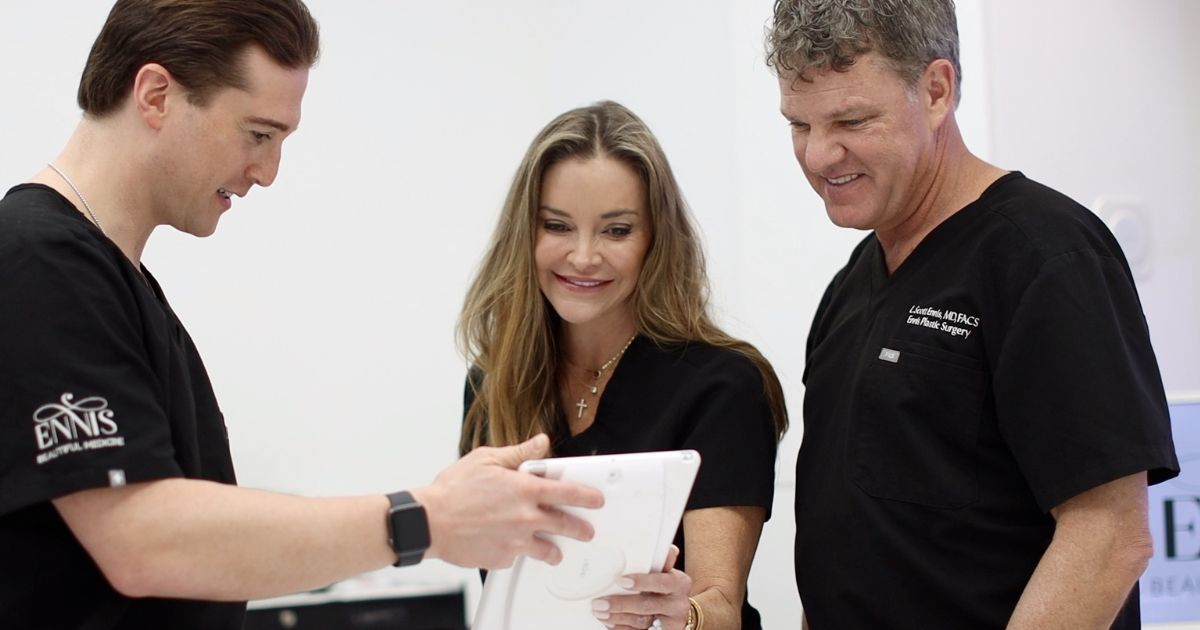
Complex implant-removal and capsulectomy cases benefit from careful preparation, clear communication, and an experienced surgical team.
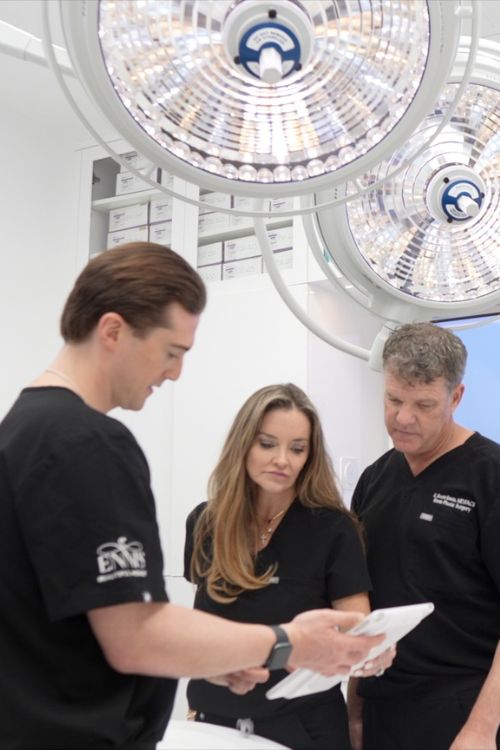
Dr. Riccelli works within the established Ennis Plastic Surgery environment alongside Dr. L. Scott Ennis, Donna Ennis, anesthesia professionals, operating-room staff, and recovery personnel.
The team reviews the surgical plan, implant history, imaging, equipment needs, recovery considerations, and individualized patient concerns before surgery.
This collaborative approach supports the practice’s focus on safety, discretion, detailed planning, and personalized care.
Tour Ennis Plastic Surgery
Experience Our Private Boca Raton Surgical Center
Ennis Plastic Surgery was designed to provide a discreet, comfortable, and personalized experience from consultation through recovery.


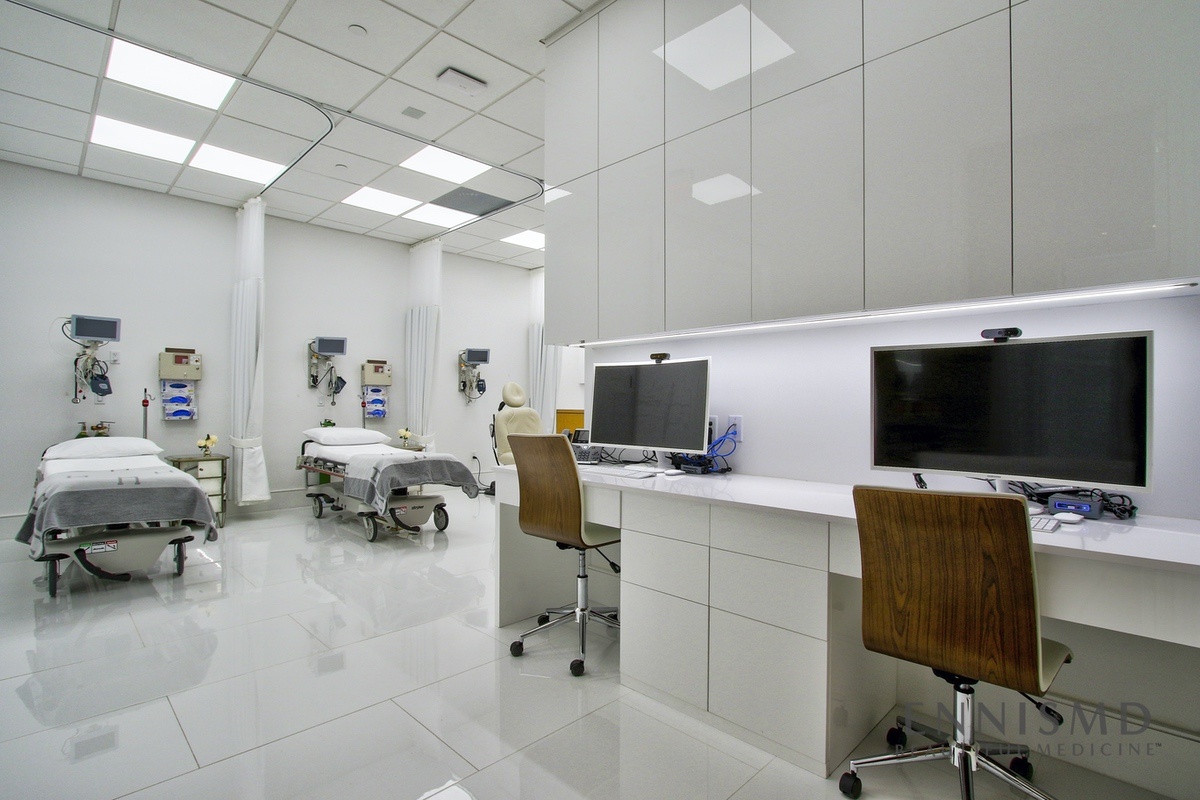
Tour Ennis Plastic Surgery
Take a brief tour of Ennis Plastic Surgery and see the boutique Boca Raton setting where patients receive personalized surgical care.
Explore the practice
- Private patient entry and lobby
- Consultation rooms
- On-site surgical areas
- Post-operative recovery spaces
- Patient checkout and follow-up areas
Why Ennis Plastic Surgery
Explant and Capsulectomy in a Private Breast Revision Practice
Ennis Plastic Surgery combines detailed implant evaluation, private consultation, surgical-team planning, and individualized breast revision care for patients considering explant and capsule surgery.
The operation is based on the implant, capsule, imaging, symptoms, breast tissue, skin, scars, chest-wall anatomy, and the patient’s desired result—not a one-size-fits-all promise of “en bloc” removal.
Meet Your Surgeon
Dr. Vincent Riccelli
Dr. Vincent Riccelli is a plastic surgeon specializing in breast revision surgery, breast implant removal, capsulectomy, breast rejuvenation, and body contouring.
For explant patients, Dr. Riccelli evaluates implant integrity, capsule anatomy, breast shape, tissue coverage, prior surgery, symptoms, and whether lift, fat transfer, exchange, or staged reshaping should be included.
His approach is built around accurate terminology, careful diagnosis, honest expectations, safety, and individualized care.

En Bloc & Capsulectomy FAQs
Frequently Asked Questions
What is an en bloc capsulectomy?
Current surgical consensus defines en bloc capsulectomy as removal of the implant capsule with a margin of uninvolved tissue, generally for suspected or confirmed implant-associated malignancy after appropriate medical workup.
What is intact total capsulectomy?
Intact total capsulectomy removes the implant and the entire capsule together without intentionally opening the capsule, when this can be performed safely.
Does every implant removal require total capsulectomy?
No. Some patients need partial or total capsule removal, while others may safely undergo implant removal without complete capsulectomy.
Can a surgeon guarantee en bloc removal?
No. Capsule thickness, fragility, rupture, prior surgery, and chest-wall attachment may make intact removal unsafe or impossible.
When is total capsulectomy considered?
Possible indications include capsular contracture, ruptured gel implants, abnormal or calcified capsule tissue, selected textured-implant concerns, and other findings determined during evaluation.
Is en bloc removal required for breast implant illness symptoms?
There is not good evidence that en bloc or total capsulectomy is required for systemic symptom improvement in every patient. The operation should be selected according to medical findings and surgical safety.
Will implant removal cure systemic symptoms?
Some patients report improvement after removal, but improvement cannot be guaranteed, and other possible medical causes should also be evaluated.
What are the risks of capsulectomy?
Risks can include bleeding, infection, contour changes, thinner tissue, sensation changes, chest-wall injury, pneumothorax, longer surgery, and the general risks of anesthesia.
Can capsulectomy be combined with a breast lift?
Yes. Lift surgery may be performed when implant removal leaves significant loose skin, tissue descent, or low nipple position.
Can fat transfer restore volume after explant?
Fat transfer may be appropriate for selected patients with enough donor fat and enough healthy breast tissue to support the transferred fat.
How long is recovery?
Recovery varies according to whether surgery includes implant removal alone, total capsulectomy, lift, fat transfer, pocket work, or another revision procedure.
What happens to the removed capsule?
Capsule tissue may be documented and sent for pathology when medically appropriate. Additional testing depends on symptoms, imaging, implant type, and operative findings.
A Clear, Safety-Based Plan
Schedule an Explant & Capsulectomy Consultation with Dr. Riccelli
If you are considering implant removal, total capsulectomy, or an en bloc procedure, Dr. Vincent Riccelli can evaluate your implants, capsule, symptoms, imaging, breast shape, and goals and explain which surgical approach is appropriate.